In this article
- Our self-heating espresso maker picks at a glance
- Self-heating vs non-heating portable espresso makers: what's the difference?
- Why choose a self-heating espresso maker?
- How to choose a portable coffee maker that heats water
- The 5 best self-heating portable espresso makers, reviewed
- How to use a self-heating espresso maker vs a hand pump
- The real cost of a self-heating espresso setup
- How we compared self-heating espresso makers
- Premierien Origin: is it worth it as a self-heating espresso maker?
- Conclusion: which one should you buy?
- FAQs
The best portable coffee maker that heats water does more than heat it: it should take the coffee you drink and charge easily on the road. This guide from Premierien compares Premierien Origin, OutIn, Wacaco and Handpresso on heating, battery, coffee and price.
Key takeaways
- Every machine here heats cold water on its own battery. They differ on price, battery size and which coffee they take.
- Origin ($119) is the only one that takes Dolce Gusto® milk pods, and it has the lowest regular price of the five.
- Want the biggest battery? The OutIn Nano 2 lists 54 Wh, about twice Origin's 28.08 Wh.
- Want to set the brew temperature? The Wacaco Pixapresso has 88, 92 and 96°C presets.
Our self-heating espresso maker picks at a glance
-
Premierien Origin$119
Our pick for most people
4 colors
-
OutIn Nano 2$152.99–179.99
Best battery
4 colors
-
Wacaco Pixapresso$159.90
Best temperature control
-
Handpresso Auto€149 (no US price)
Removable battery
-
OutIn Nano (1st gen)$149.99
Lightest
Prices from each brand's US site on October 24, 2026. They change, so check before you buy. None of these take Nespresso® Vertuo pods.
Gear in this guide
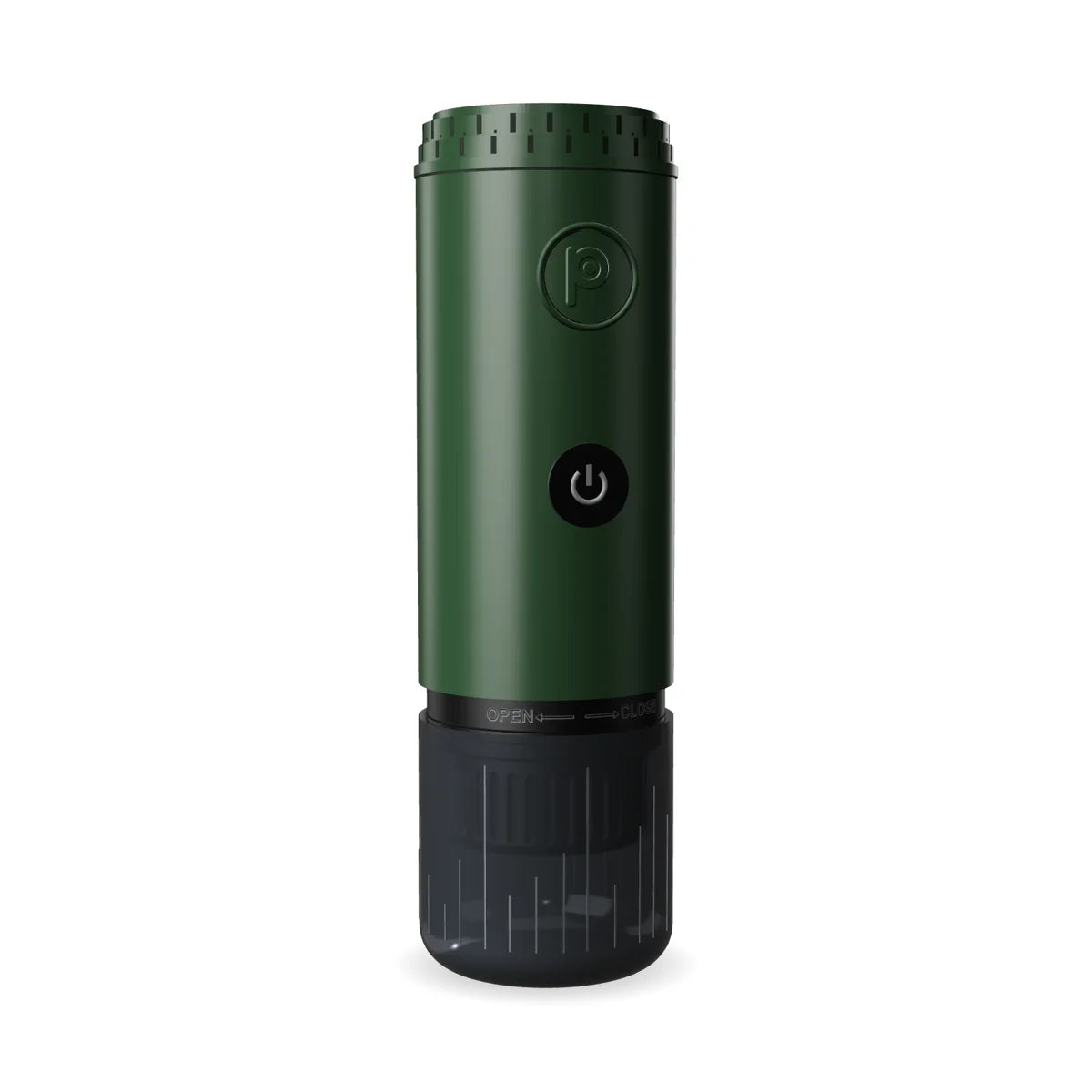
Origin 3-in-1 Portable Espresso MakerGrounds basket, Nespresso® compatible adapter and Dolce Gusto® compatible holder all in the box.
Self-heating vs non-heating portable espresso makers: what's the difference?

What is a self-heating portable espresso maker?

A self-heating portable espresso maker has a heater and a battery inside, so it warms cold water before the pump pushes it through the coffee. You fill it from a water bottle, press a button and wait for it to heat. Shops also call these battery powered portable coffee makers.
What is a non-heating portable espresso maker?
A non-heating portable espresso maker builds the pressure but can't warm the water, so you bring it hot from a kettle, a stove or a thermos. Most are hand pumps: you press or pump to push the water through the coffee. Some plug-in machines heat only from a car socket or the wall.
Where self-heating and non-heating machines differ
- Hot water: a self-heating machine starts from cold water; a non-heating one needs water you've already heated.
- Power: a self-heating machine needs charging; a hand pump needs nothing but your arm.
- Weight: the battery and heater make a self-heating machine about twice as heavy.
- Where you can brew: a self-heating machine brews anywhere; a non-heating one brews wherever your hot water is.
Why choose a self-heating espresso maker?

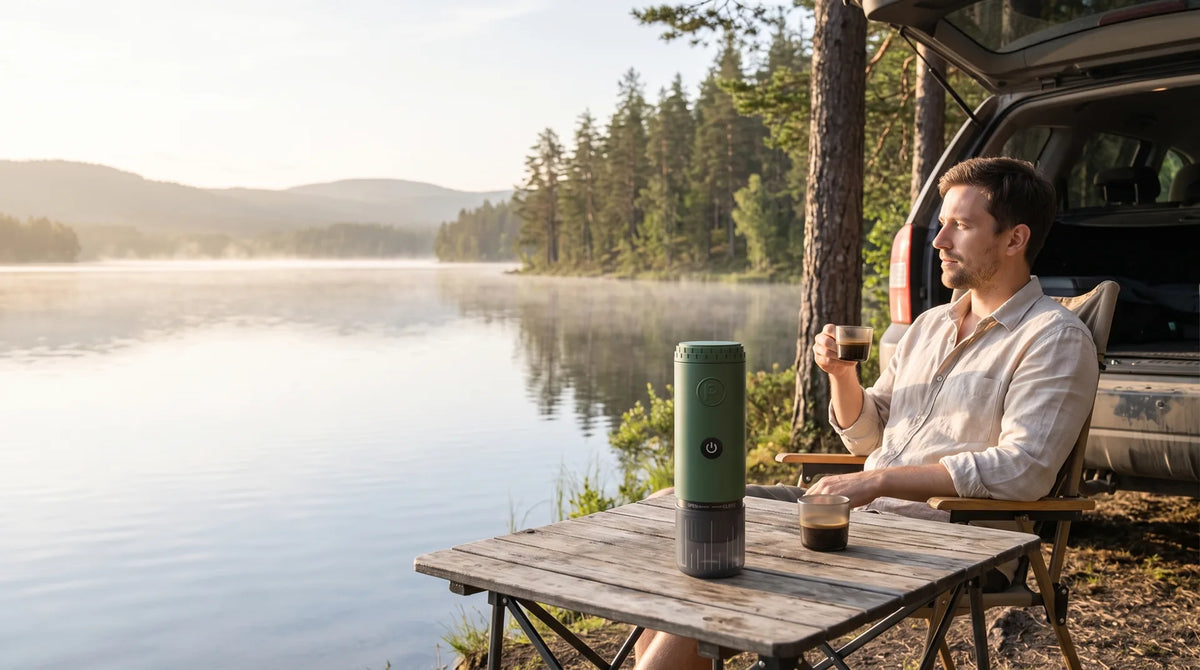
The heater is what lets you brew where there's no kettle: a trail, a beach, a desk at work or a car at a rest stop. It also means you don't have to light a stove at 6 a.m. for one shot.
- Instead of a hand pump: no thermos to fill and no hot water to plan around. A hand pump is lighter, though.
- Instead of a 12V plug-in: it brews with the engine off and away from the car.
- Instead of instant coffee: a 19 to 21 bar pump makes real espresso with crema.
The trade-offs: a battery big enough to heat water makes these machines heavier than a hand pump, usually 670 to 830 g against about 290 to 350 g. Heating cold water also uses most of the charge. If you always camp with a stove, a hand pump may be all you need.
How to choose a portable coffee maker that heats water
Start with where the hot water comes from

This decides everything else. If you'll often have hot water from a kettle or thermos, battery size matters less, because most of these machines can skip the heating. If you'll mostly start from cold water out of a bottle, the battery has to do the heating every time, and a bigger one goes further.
Battery: watt-hours and charge time
Watt-hours tell you how much energy the battery holds. The brands' own numbers show how much heating costs. OutIn lists up to 9 cups from room-temperature water for the Nano 2, but over 600 with preheated water. For the first Nano it's up to 5 brews from cold against over 200 with hot water.
Charge time matters too. OutIn says the Nano 2 refills in about 100 minutes on a 45 W charger; Wacaco gives about two and a half hours for the Pixapresso.
Read heat claims with their conditions
Heat-up claims aren't measured the same way. OutIn's 159 seconds for the Nano 2 starts from 25°C water, Wacaco's 180 seconds for the Pixapresso is for 35 ml at 88°C, and Handpresso gives 3 to 4 minutes for a 40 ml espresso on the Auto. Cold mornings and bigger shots take longer on any machine, so compare the conditions as well as the numbers.
Pressure: the box vs the shot
The bar number on the box is the pump's peak. What reaches the coffee while the shot runs is lower. Origin lists both: 19 bar peak and 9 to 12 bar while brewing, which is the range espresso is usually brewed at. Most brands list only the peak, so treat 20 or 21 bar as a maximum rather than a promise.
Which coffee do you drink?
Every machine here takes ground coffee and Nespresso Original capsules, and none takes Vertuo pods. If you have Dolce Gusto pods at home, only Origin takes them, milk pods included. Capsules are quicker to clean up outdoors; grounds let you use any bean. More in grounds or capsules: what to pack.
Temperature
Most of these heat to about 92–93°C, which suits most espresso. Origin brews at 92°C, the Nano at up to 92°C and the Nano 2 at 93°C; Handpresso says the Auto is ready at 92°C. The Pixapresso lets you pick 88, 92 or 96°C, which is handy if you switch between light and dark roasts.
The 5 best self-heating portable espresso makers, reviewed
1. Our pick for most people: Premierien Origin

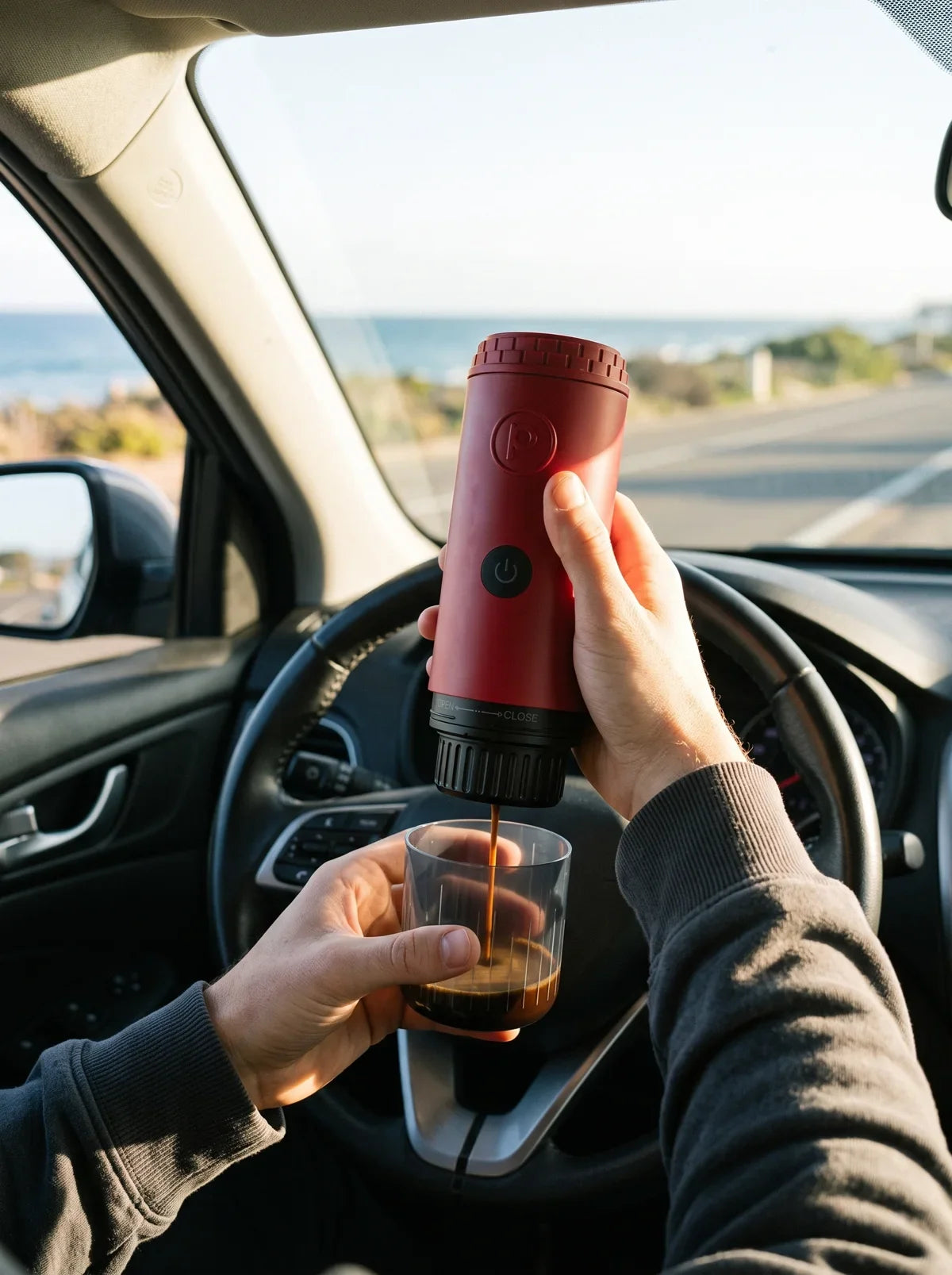
It's early, the air is cold and the stove is still in the car. With Origin you fill the tank straight from your water bottle, hold the button for 2 seconds and it heats the water to 92°C (198°F), then brews. Got hot water from a thermos? Press twice and it skips the heating, which also saves battery.
Why it's our pick: it's the only machine here that takes Dolce Gusto pods at all, milk pods included, and at $119 it has the lowest regular price of the five. The other four take ground coffee and Nespresso Original capsules only.
What it was like on our trip: we brewed in the car with ground coffee on a camping trip. The pump pushed water through strong and steady with no sputtering, it stayed quiet, and the shots came out rich under a thick, foamy crema at about 80°C (176°F) in the cup.
Every kind of coffee you might pack: a grounds basket with lid, a Nespresso Original compatible adapter and a Dolce Gusto compatible holder all come in the box. Lattes and cappuccinos from Dolce Gusto milk pods work too: brew the milk pod and the coffee pod one at a time, with a refill in between.
Pressure and tank: the pump peaks at 19 bar and holds 9 to 12 bar while the shot runs. The 100 ml stainless steel tank takes 50 ml for a single or 70 ml for a double.
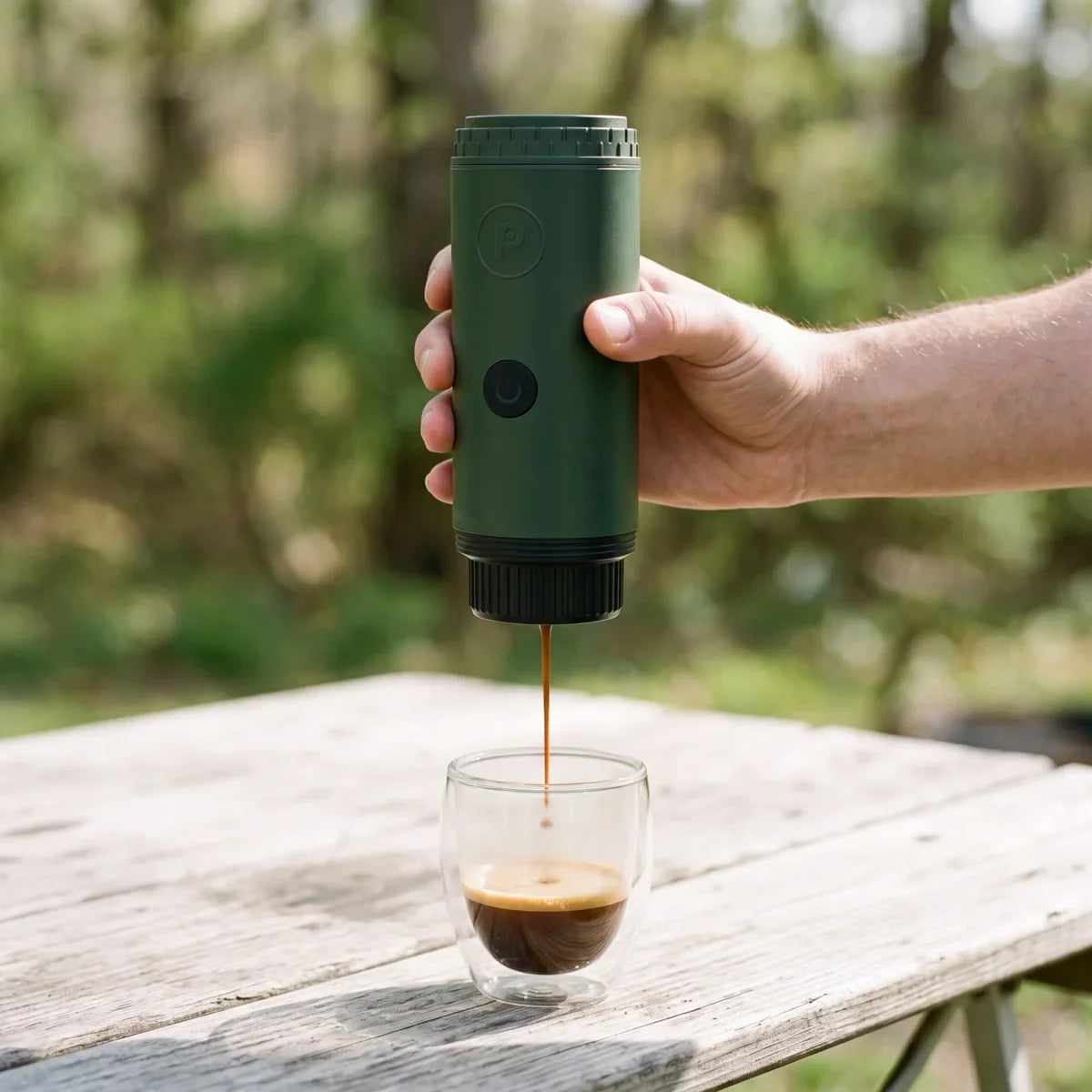
Charging and size: it charges over USB-C (10V · 2.25A) from a wall adapter, laptop, power bank or car charger. It's about the size of a 750 ml water bottle, so it rides in a backpack side pocket, and it comes in Forest Green, Midnight Black, Cream and Canyon Red.
Flying and cleaning: the 28.08 Wh battery is well under the usual 100 Wh carry-on limit, so pack it in your carry-on with the tank empty. To clean it, run one brew of clean water with no coffee, then rinse the basket or holder.
Cold mornings: heating cold water takes more of the charge on any battery machine. On a long day out, start with hot water from a thermos when you have it, and save the heater for the stops where you don't.
Switch coffee mid-trip: if the Dolce Gusto pods run out, swap to the grounds basket or the Nespresso compatible adapter in seconds. There's nothing else to buy or pack.
| Heats water | Yes, on battery, to 92°C (198°F) |
|---|---|
| Takes | Grounds, Nespresso Original compatible and Dolce Gusto compatible pods, milk pods included |
| Pump | 19 bar peak, holds 9–12 bar while brewing |
| Battery | 7,800 mAh (28.08 Wh), USB-C |
| Tank | 100 ml (50 ml single, 70 ml double) |
| Size | 75 × 248 mm, about 776 g |
| Colors | Forest Green, Midnight Black, Cream, Canyon Red |
| Price | $119, all three parts in the box |
Pros
- Lowest regular price of the five ($119)
- The only one that takes Dolce Gusto pods, milk pods included
- Rich shots with thick crema on our trip
- Quiet, USB-C charging
- Free shipping, 100-day returns
Cons
- Smaller battery than the OutIn Nano 2 (28.08 vs 54 Wh): start with hot water on long trips
- No temperature presets: it brews at 92°C, which suits most espresso
Who it's for: you want the water heated for you and you drink more than one kind of coffee. See Origin in all 4 colors: free shipping, 100-day returns.
2. Best battery: OutIn Nano 2
What it does well: the Nano 2 is the power pick. OutIn lists a 54 Wh battery and a 120 W heater that takes room-temperature water (25°C) to 93°C in "as little as 159 seconds". It also lists a pump of up to 21 bar and 45 W USB-C fast charging. OutIn says that's up to 9 cups from room-temperature water, or over 600 extractions with preheated water.
The catch: it lists at $179.99 (we saw it on sale for $152.99), the most here, and it takes ground coffee and Nespresso Original compatible capsules but no Dolce Gusto.
Pick it if battery comes first on long trips and you only use grounds or Nespresso pods.
| Heats water | Yes, on battery, 25 → 93°C |
|---|---|
| Takes | Grounds, Nespresso Original compatible capsules |
| Battery | 54 Wh, 45 W USB-C PD |
| Tank | 85 ml |
| Weight | 740 g |
| Price | $179.99 list, seen at $152.99 on sale |
Pros
- Biggest battery in this list
- Fastest heating claim
- Fast USB-C charging
Cons
- Most expensive here
- No Dolce Gusto
- Smaller tank than Origin
3. Best temperature control: Wacaco Pixapresso
What it does well: the Pixapresso is the only machine here with brew temperature presets: 88, 92 or 96°C. It has the biggest tank in this list at 120 ml, a 20 bar pump and an adjustable basket for 8 to 16 g of ground coffee, plus Nespresso capsules. Wacaco says it brews in 180 seconds (for 35 ml at 88°C) and makes up to 5 espressos per charge.
The catch: its 3000 mAh 3S battery takes about two and a half hours to charge over USB, there's no Dolce Gusto option, and at $159.90 it costs $40 more than Origin.
Pick it if you like to tune the temperature to each bean.
| Heats water | Yes, on battery, presets 88 / 92 / 96°C |
|---|---|
| Takes | Grounds (8–16 g), Nespresso capsules |
| Battery | 3000 mAh 3S, USB-C |
| Tank | 120 ml |
| Weight | 755 g |
| Price | $159.90 |
Pros
- Three temperature presets
- Biggest tank here
Cons
- No Dolce Gusto
- $40 more than Origin
4. Removable battery: Handpresso Auto
What it does well: the Handpresso Auto heats water on its own battery to 92°C and runs a 19 bar pump. Handpresso calls the battery "removable and rechargeable": 9000 mAh, or 32 Wh, with a 100 ml tank. It says one charge makes up to 5 espressos of 40 ml or 3 lungos of 80 ml from 20°C water.
The catch: at 830 g it's the heaviest here, and Handpresso's site lists it in euros only: €149 on sale, €179 regular, with no US price. It takes Nespresso Original compatible capsules, and ground coffee only through a reusable capsule that holds 7 g. There's no Dolce Gusto option, and Handpresso says it doesn't accept Vertuo.
Pick it if you're buying in Europe and want a battery you can take out.
| Heats water | Yes, on battery, to 92°C |
|---|---|
| Takes | Nespresso Original compatible capsules; grounds in a 7 g reusable capsule |
| Battery | 9000 mAh (32 Wh), removable, USB-C |
| Tank | 100 ml |
| Weight | 830 g |
| Price | €149 on sale (€179 regular), no US price |
Pros
- Battery comes out
- Heats to 92°C
Cons
- Heaviest here (830 g)
- Euro price only
- No Dolce Gusto
5. Lightest: OutIn Nano (1st generation)
What it does well: the original Nano is still on sale at $149.99, and at 670 g it's the lightest machine here. It heats to 92°C, has a 20 bar pump and an 80 ml tank, and it charges from USB or a 12/24 V car charger. OutIn lists a 200-second heat-up.
The catch: the battery is the smallest in this list at 2,500 mAh. OutIn lists up to 5 brews from room-temperature water on a full charge, or over 200 with hot water. It takes grounds and Nespresso Original capsules, with no Dolce Gusto option.
Pick it if you hike, want heat and count every gram.
| Heats water | Yes, on battery, up to 92°C |
|---|---|
| Takes | Grounds, Nespresso Original capsules |
| Battery | 2,500 mAh 3S, USB-C or 12/24 V car charger |
| Tank | 80 ml |
| Weight | 670 g |
| Price | $149.99 |
Pros
- Lightest self-heating machine here
- Car charger supported
Cons
- Smallest battery: up to 5 brews from cold water
- No Dolce Gusto
- Costs more than Origin
How to use a self-heating espresso maker vs a hand pump

The steps look alike; the hot water is the difference. With a hand pump you heat the water before you leave or at the stove. With Origin you pour in water from your bottle and the machine heats it.
With a hand pump
- Heat the water first, on a stove or with a kettle, or fill a thermos before you leave.
- Fill the basket with coffee, or fit a capsule adapter if your pump takes one.
- Pour the hot water into the tank.
- Pump by hand until the shot is done. The coffee is only as hot as the water you brought.
- Rinse the basket and let the parts dry.
With Origin
- Charge it over USB-C before the trip.
- Add the coffee: fill the grounds basket, or drop a capsule into its adapter or holder.
- Pour in water: fill to 50 ml for a single or 70 ml for a double, and stay under the MAX line.
- Cold water? Hold the button for 2 seconds: Origin heats it to 92°C, then brews. Hot water? Double-press: it brews right away and saves battery.
- Clean up: rinse the basket or adapter, run one brew of clean water with no coffee, and wipe the body.
Not sure which water to start with? Our Origin guide covers when to use hot or cold water.
The real cost of a self-heating espresso setup
Compare what it costs to brew the coffee you actually drink, and what each machine leaves out. Prices are from each brand's US site on October 24, 2026.
Premierien Origin: $119, all three coffees included
- Free in the box: all three coffee parts (basket, Nespresso compatible adapter and Dolce Gusto compatible holder), plus the travel cup.
- The lowest regular price of the five.
- Free shipping and 100-day returns.
- The one catch: it's sold only on our site.
The other four: more money, fewer coffees
- Wacaco Pixapresso, $159.90: grounds and Nespresso capsules only, and Wacaco gives about two and a half hours to charge over USB.
- Handpresso Auto, €149 on sale: no US price on Handpresso's site, ground coffee only through a 7 g reusable capsule, and Handpresso lists 2.5 hours to recharge on a 20 W charger.
- OutIn Nano, $149.99: grounds and Nespresso capsules only, and OutIn lists up to 5 brews from room-temperature water per charge.
- OutIn Nano 2, $152.99–179.99: grounds and Nespresso capsules only, and the fast charging OutIn lists needs a 45 W USB-C PD charger.
- None of the four takes Dolce Gusto pods, so if you have them at home, they stay at home.
Running costs: capsules cost more per cup than ground coffee but are faster to clean up away from a sink. Starting with hot water when you have it saves charging on any of these.
Cost per brew: divide the price by how often you'll realistically brew. A self-heating machine used every weekend morning for a year, about 100 brews, works out to a little over $1 a brew for Origin before the coffee.
How we compared self-heating espresso makers
For this guide, "compared" means a check of each machine's specs, manual and price on the brand's own site, not a lab test of all five. We make Origin and have brewed with it. For the other four we rely on what their makers publish.
Prices and specs were checked on October 24, 2026. Heat-up times and brews per charge are the brands' own claims, and each brand measures them differently, so we list the condition next to the number.
What we compared on each self-heating machine


- Heating on battery: does it heat cold water with no outlet, and to what temperature.
- Battery: size in watt-hours or mAh, how it charges, and whether you can swap it.
- Heat claims: heat-up time and brews per charge, and the water temperature each brand measured from.
- Pressure: the peak on the box and, where listed, the pressure while the shot runs.
- Coffee: grounds, Nespresso Original compatible pods, Dolce Gusto compatible pods and milk pods.
- Size and weight: what you'll carry.
- Real price: what it costs to brew the coffee you drink.
To make the list, a machine had to heat water on its own battery and be sold on the brand's own site; Handpresso lists euro prices only. Where another machine beats Origin, we've said so.
Premierien Origin: is it worth it as a self-heating espresso maker?
If you want hot espresso without carrying a kettle, Origin is worth considering. It won't beat the OutIn Nano 2 on battery size, so think of it as the self-heating machine for people who drink more than one kind of coffee, at the lowest regular price of the five.
Order on our site and delivery is free anywhere we ship. You get 100 days to try it on real mornings, and if it doesn't earn its spot in your bag, send it back. We only make this one espresso machine, so questions go to people who use it.
Shop Origin: free shipping, 100-day returns
Hot water from cold, on battery
Hold the button for 2 seconds and Origin heats cold water to 92°C before it brews. Press twice with hot water from a thermos and it brews right away, which is the way to stretch the battery on a long trip.
Heater plus three kinds of coffee
The heater is half of it; the other half is the coffee. Origin takes grounds, Nespresso Original compatible capsules and Dolce Gusto compatible pods, milk ones included. That only matters if you'll use more than one, so be honest about what you drink before paying for it.
Who should buy a self-heating Origin?
Origin is worth a look if:
- You brew where there's no kettle: trails, beaches, a desk at work
- You drink more than one kind of coffee
- You want Dolce Gusto milk drinks away from home
- You want the lowest regular price of the five
If battery size is all that matters, the Nano 2's 54 Wh battery goes further. If you always camp with a stove, a hand pump is lighter and cheaper.
Want all three coffee types? See the best portable coffee makers for espresso. Have Dolce Gusto pods? See how Origin compares with home Dolce Gusto machines.
Conclusion: which one should you buy?
All five are portable coffee makers that heat water on battery, so the choice comes down to coffee, battery and budget. Want the biggest battery? The OutIn Nano 2. Want temperature presets? The Pixapresso. Want a battery you can take out, and buying in euros? The Handpresso Auto. Counting every gram? The first OutIn Nano.
Want the lowest regular price and every kind of coffee, Dolce Gusto milk pods included? That's Origin, at $119 in four colors, with free shipping and 100 days to send it back. You can also browse all our self-heating portable espresso makers.
Not sure which one fits? Email support@premierien.com. A real person reads every message.
FAQs
What is the best portable coffee maker that heats water?
For most people it's Origin ($119): it heats cold water on battery, takes grounds, Nespresso Original compatible and Dolce Gusto compatible pods, milk pods included, and has the lowest regular price of the five. If battery size matters most, look at the OutIn Nano 2.
Do self-heating espresso makers need hot water?
No. That's the point: pour in cold water and they heat it. With Origin you hold the button for 2 seconds. If you do have hot water, a double-press skips the heating and saves battery.
How many brews do you get per charge?
It depends on the machine and on whether you start with cold or hot water, because heating cold water uses most of the battery. When you compare brands, check whether their figure was measured from cold water or from preheated water.
Does a higher bar number make better espresso?
Not by itself. The number on the box is the pump's peak, and espresso is usually brewed at around 9 bar. A machine that lists its brewing pressure, like Origin's 9 to 12 bar, tells you more than a higher peak number.
Can I take a self-heating espresso maker on a plane?
Usually, in your carry-on with the tank empty, if the battery is under 100 Wh. Every machine in this list is. Lithium batteries can't go in checked bags, so check your airline's rules before you fly.
Which self-heating espresso maker has the biggest battery?
The OutIn Nano 2, at 54 Wh, about twice Origin's 28.08 Wh. If you'll often have hot water from a thermos, any of these goes much further, because heating cold water uses most of the charge.
Nespresso® and Dolce Gusto® are trademarks of Société des Produits Nestlé S.A. Premierien is not affiliated with Nestlé.