In this article
- Best portable coffee makers at a glance
- Portable coffee maker types: espresso maker or press?
- Why choose a portable coffee maker?
- How to choose a portable coffee maker
- The 6 best portable coffee makers, reviewed
- How to use a portable espresso maker vs a press
- The real cost of a portable coffee maker
- Premierien Origin: is it worth it as your portable coffee maker?
- Conclusion: which portable coffee maker should you buy?
- FAQs
The best portable coffee maker depends on how you want to brew away from the kitchen: on battery, by hand or on a stove. This guide from Premierien compares Premierien Origin with five rival makers on coffee, hot water, weight and price.
Key takeaways
- Best overall: Premierien Origin, $119. Heats cold water on battery and takes grounds and two kinds of pods.
- Best battery: HiBREW H4C Explorer. The biggest battery here, for black coffee.
- Lightest espresso maker: Wacaco Nanopresso. A hand pump at 336 g, if you carry hot water.
- Best for a full cup: AeroPress Go. A simple press that packs into its own mug.
- Best for coffee on the move: Wacaco Pipamoka. Brews straight into an insulated mug.
- Best for a camp stove: Bialetti Moka Express. The classic moka pot, nothing to charge.
Best portable coffee makers at a glance
-
Premierien Origin$119
Best overall: heats water, takes all three
4 colors
-
HiBREW H4C Explorer$118–139
Best battery
2 colors
-
Wacaco Nanopresso$64.90
Lightest espresso maker
-
AeroPress Go$49.95
Best for a full cup
-
Wacaco Pipamoka$49.90
Best for coffee on the move
-
Bialetti Moka Expressabout $35–40
Best for a camp stove
We took prices from each brand's US site on October 24–26, 2026. The Bialetti price comes from US stores on Google Shopping. Prices change, so check before you buy.
Which one is for you?
- I want espresso anywhere, with no kettle: Origin.
- I drink black coffee and want the biggest battery: HiBREW H4C Explorer.
- I carry hot water and count every gram: Wacaco Nanopresso.
- I want a big, smooth cup rather than a shot: AeroPress Go or Pipamoka.
- I cook on a camp stove anyway: Bialetti Moka Express.
| Maker | How it brews | Coffee | Heats water |
|---|---|---|---|
| Premierien Origin | Battery pump | Espresso; grounds + 2 pod types | Yes, on battery |
| HiBREW H4C Explorer | Battery pump | Espresso; grounds + 2 pod types | Yes, on battery |
| Wacaco Nanopresso | Hand pump | Espresso; grounds | No |
| AeroPress Go | Press | Full cup; grounds | No |
| Wacaco Pipamoka | Vacuum press | Full cup; grounds | No |
| Bialetti Moka Express | Stovetop | Strong cup; grounds | On a stove |
Gear in this guide
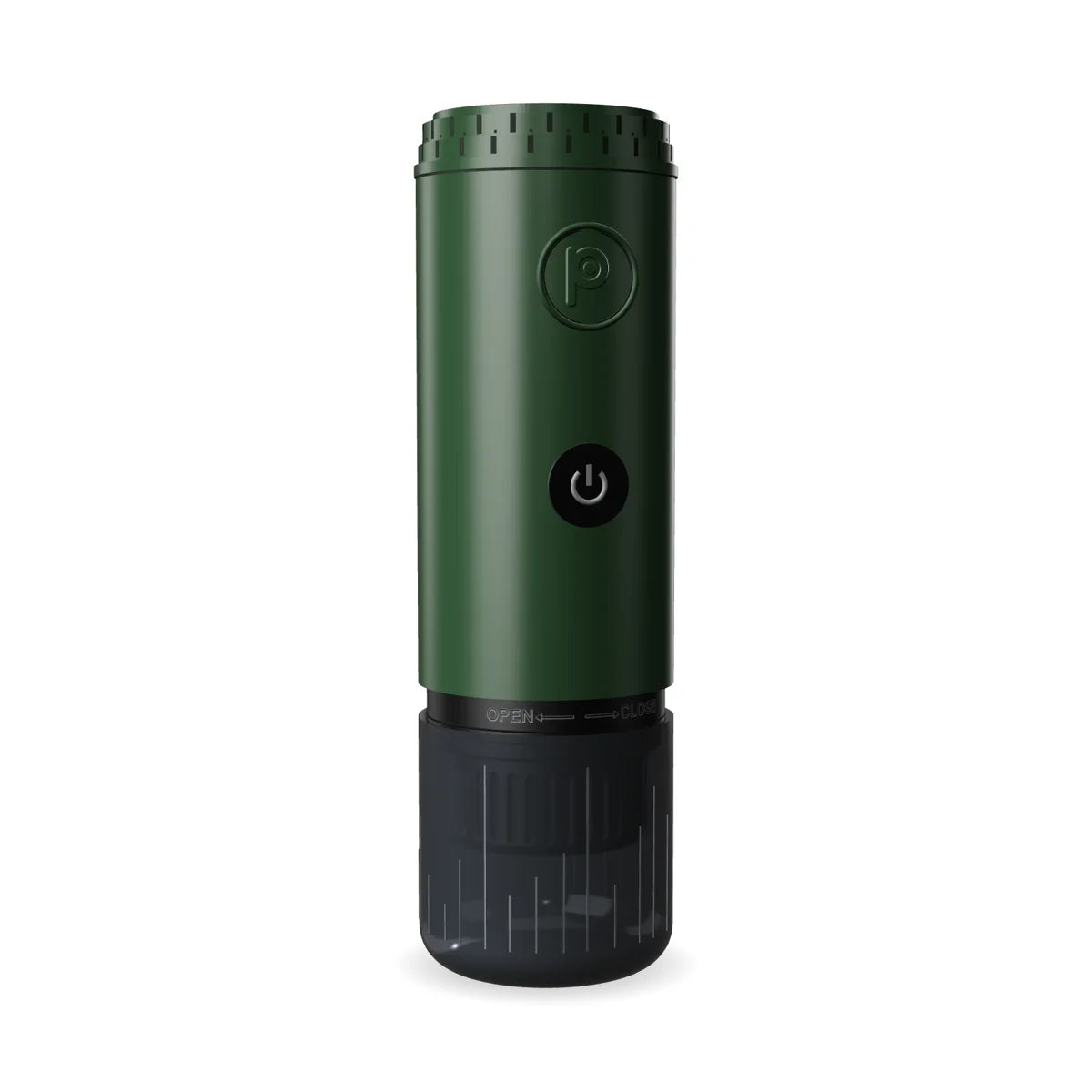
Origin 3-in-1 Portable Espresso MakerGrounds basket, Nespresso® compatible adapter and Dolce Gusto® compatible holder all in the box.
Portable coffee maker types: espresso maker or press?

Every portable coffee maker here is one of two kinds. One pushes water through the coffee with a pump. The other steeps it, or uses a stove.
What is a portable espresso maker?

A portable espresso maker pushes hot water through finely ground coffee under pump pressure. You get a short, full-bodied shot with crema. Battery models pump for you, and some heat the water too. Manual models build the pressure with a hand pump. You'll also see them sold as portable espresso machines or mobile espresso machines.
What is a press or stovetop coffee maker?
A press or stovetop coffee maker brews a fuller cup without a pump. A press, like a French press, steeps the coffee and pushes or pulls the water through a filter. A stovetop moka pot uses steam to push water up through the coffee. Both are simple and light, but they need hot water or a stove.
Portable espresso maker vs moka pot
A moka pot is not an espresso maker, even though it's often called a stovetop espresso maker. It brews with low steam pressure from the burner, well below the 9 bar an espresso pump works at. The coffee is strong and bold, but it has little or no crema.
A portable espresso maker works at espresso pressure, so the shot tastes like one from a café. The moka pot wins on price and has nothing to charge. The espresso maker wins if you want a real shot, or have no stove.
Where espresso makers and presses differ
- The coffee: an espresso maker pulls a short, concentrated shot; a press or moka pot makes a bigger, strong cup.
- Hot water: battery espresso makers can heat their own; presses need a kettle or thermos, and a moka pot needs a stove.
- Power: battery models need charging; hand pumps, presses and moka pots need nothing.
- Pods: some espresso makers take capsules; presses and moka pots take ground coffee only.
Why choose a portable coffee maker?
Because good coffee shouldn't stop where the kitchen ends. A portable coffee maker brews the coffee you like in a car, a tent or a hotel room. It works at a desk with no café nearby, too.
- Instead of gas-station or hotel coffee: your own beans or capsules, made the way you like them.
- Instead of buying coffee every stop: one machine pays for itself after a few trips.
- Instead of instant coffee: a real shot or a full cup of coffee brewed from ground coffee.
The trade-offs: most portable coffee makers need hot water you bring. The ones that heat it add a battery and some weight. Choose by where your hot water will come from.
How to choose a portable coffee maker
Espresso or a full cup?
If you want espresso, buy a portable espresso maker. A press like the AeroPress Go or the Pipamoka makes a smooth, full cup. A moka pot makes a strong, bold one. Only a pump-pressure machine pulls an espresso shot with crema.
Where will the hot water come from?
This decides more than anything else. No kettle, no stove? Only a battery-powered maker that heats water works from cold water. Origin and the H4C do it. So do makers like the OutIn Nano, which we compare in our guide to portable coffee makers that heat water.
Always have a thermos or a camp stove? A hand pump, a press or a moka pot is lighter and simpler. Not sure which to pour in? Here's when to use hot or cold water.
Electric or manual portable espresso machine?
A portable electric espresso machine does the work for you. Press a button and it pumps, and on Origin and the H4C it heats too. A manual one is lighter and never needs charging. But you pump every shot by hand, and heating water is up to you.
Grounds, Nespresso or Dolce Gusto pods?
Check pods by name. "Nespresso compatible" nearly always means the Original line; Vertuo pods won't fit any pick here. Dolce Gusto pods need their own holder, and only Origin takes the milk pods for lattes. Presses and moka pots take ground coffee only. Drinking Dolce Gusto at home too? See Dolce Gusto machines, portable vs home.
Pick the right grind
Match the grind to the maker. An espresso maker needs a fine grind, close to powdered sugar, so the water meets resistance in the filter basket. A press or a Pipamoka wants medium to coarse, and a moka pot sits in between.
Pre-ground coffee is fine for a start, but beans ground just before you brew taste brighter. Our manual coffee grinder with 40 settings works as an espresso grinder on its fine settings. Turn it coarser for a French press. It packs small, too.
How mini is a mini portable espresso machine?
Expect about 336 g for a hand pump and 600 to 780 g for a battery machine. The extra weight is the heater and battery. On a long hike that matters. On a car trip or in a campervan, it doesn't. A carry case keeps everything together: the Origin travel case holds the machine in a shaped base, with a mesh pocket for pods.
The 6 best portable coffee makers, reviewed
How we compared portable coffee makers


"Compared" here means a check of each maker's specs, manual and price on the brand's own site, not a lab test of all six. We make Origin and have brewed with it ourselves on a camping trip. We haven't brewed with the others, so we don't rank how their coffee tastes. We picked one maker for each way of brewing, from the brands that come up most for portable coffee.
- How it brews: battery pump, hand pump, press or stovetop.
- The coffee it makes: an espresso shot or a full cup.
- Hot water: heats its own, needs a kettle or thermos, or needs a stove.
- Coffee types: ground coffee, Nespresso Original pods, Dolce Gusto pods.
- Weight and packing: what you'll carry.
- Real price: what it costs to start, and what each brew needs.
1. Best overall: Premierien Origin

Gas-station coffee is the saddest part of a road trip. Origin fixes that by heating its own water. Fill it straight from your water bottle and hold the button for 2 seconds. It warms room-temperature water to 92°C (198°F), then brews. Already have hot water from a kettle or thermos? Press twice and it skips the heating.
Why it's our pick: no other machine here does both jobs. It heats water on battery, and it takes grounds, Nespresso Original and Dolce Gusto pods, milk pods included. The H4C also heats on battery, but its manual rules out milk pods. Every other pick needs hot water or a stove. So one machine covers the car, the campsite and your desk at work, with nothing extra to pack.
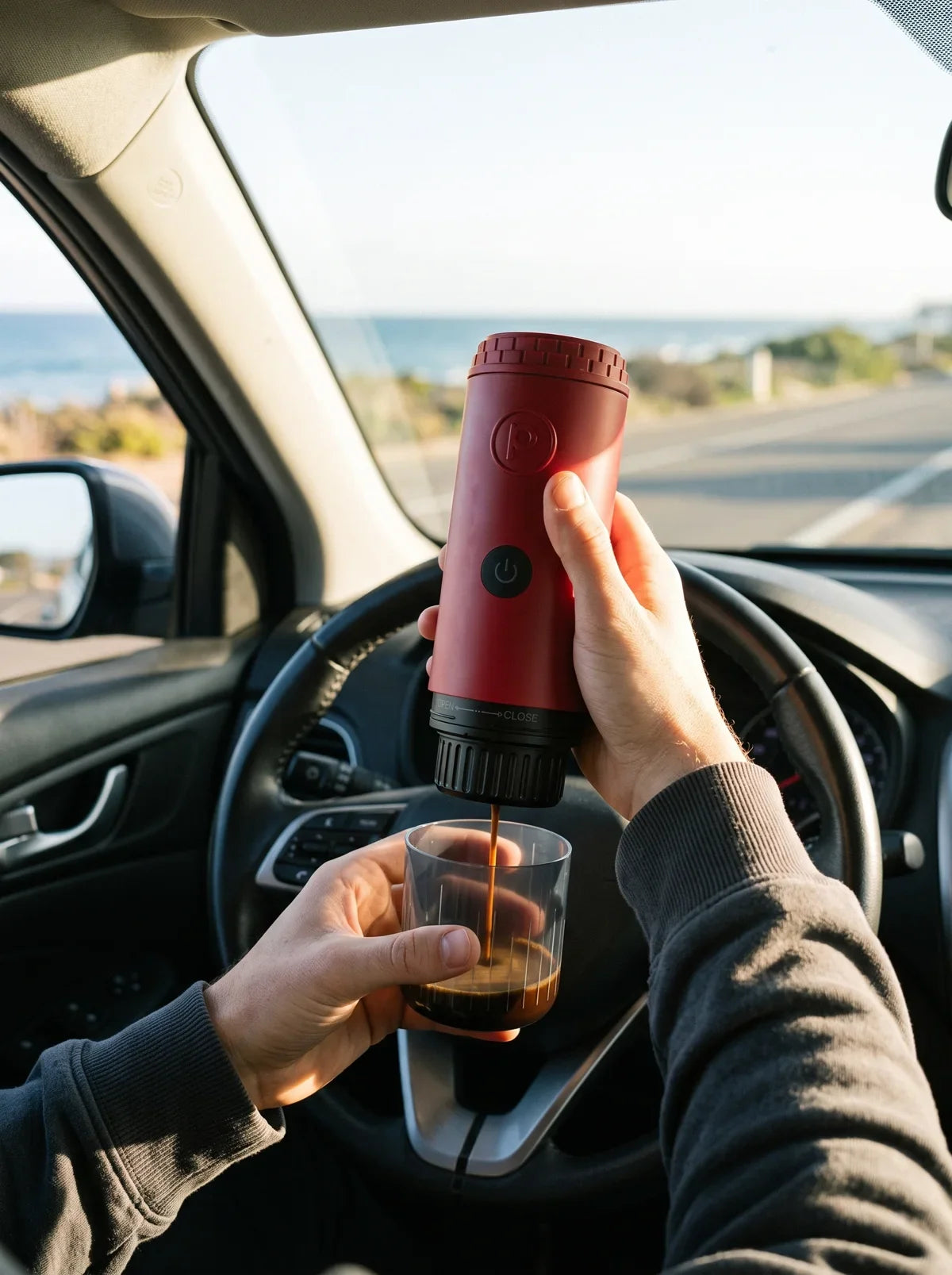
On our camping trip: we brewed in the car with ground coffee. The pump pushes water through strong and steady, with no sputtering and no choking on the coffee puck, and it's quiet while it runs. The shots came out rich and bold under a thick, foamy crema, at about 80°C (176°F) in the cup.
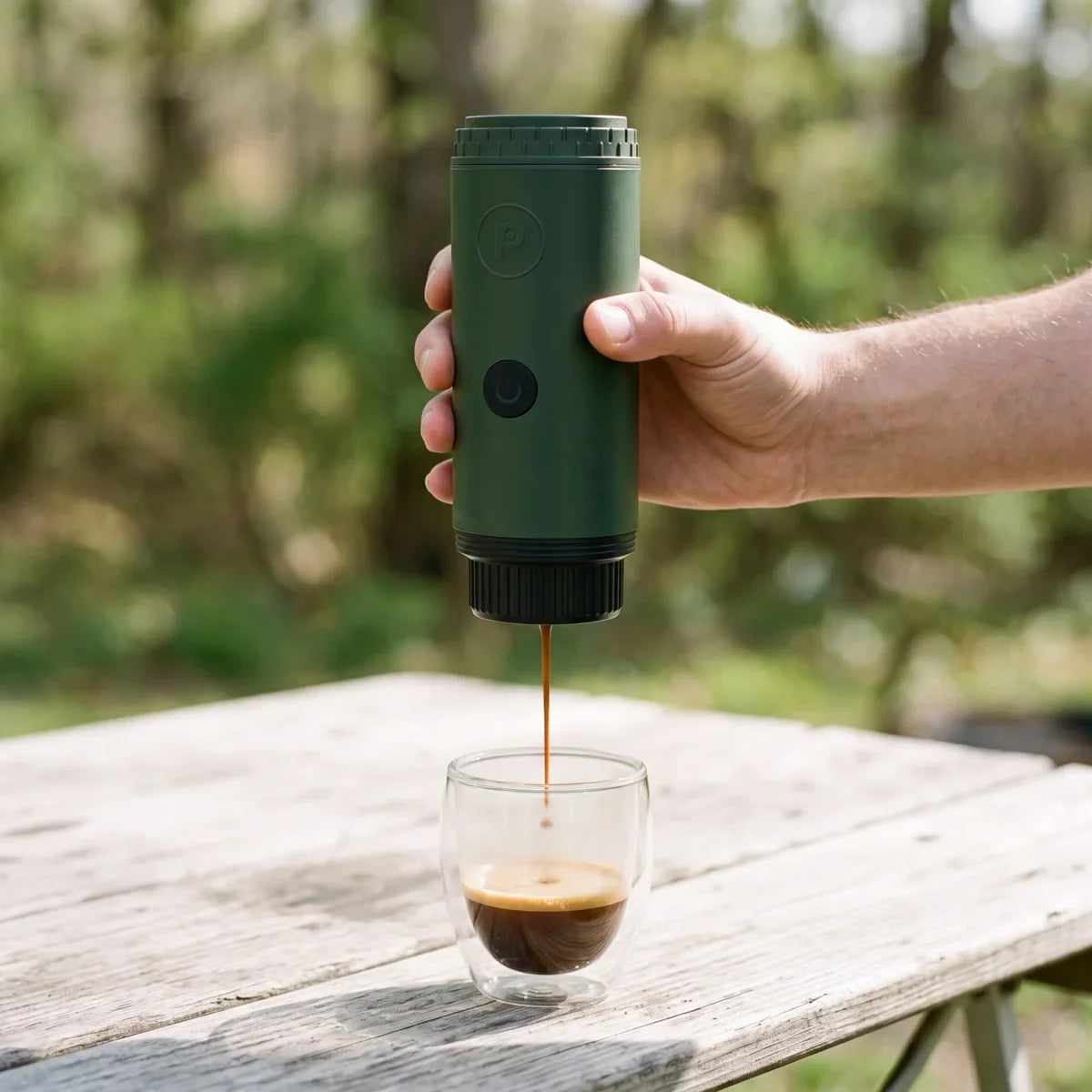
Poured into a double-wall glass espresso cup, you can watch the crema settle. We made 10 cups over the trip and never had to recharge. It sits comfortably in one hand, which helps in a cramped car.
All three parts come in the box. You get a grounds basket, a Nespresso® Original compatible adapter and a Dolce Gusto® compatible holder. The parts swap in seconds. The Dolce Gusto side takes milk pods too, so a latte at the campsite is on the menu. Prefer fresh milk? A rechargeable milk frother with a stainless steel whisk foams it in seconds.
Size, charging and colors: Origin measures 75 × 248 mm and weighs about 776 g. That's heavier than a hand pump, because the heater and battery are inside. The 100 ml tank is 304 stainless steel: 50 ml for a single, 70 ml for a double. The pump peaks at 19 bar and holds 9 to 12 bar while the shot runs.
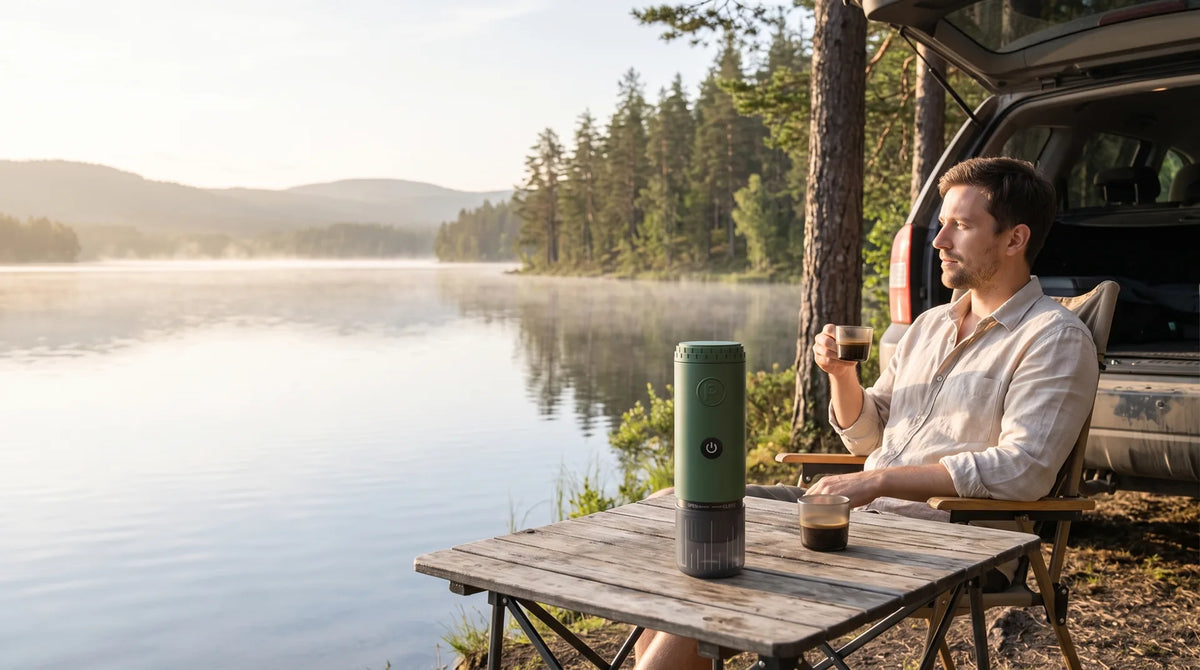
It charges over USB-C from a wall adapter, laptop, power bank or car charger. The shot pours into the travel cup from the box, or into a small espresso tumbler for the road. Pick Forest Green, Midnight Black, Cream or Canyon Red; every color costs the same $119.
| Type | Battery espresso maker that heats water |
|---|---|
| Takes | Grounds, Nespresso Original compatible and Dolce Gusto compatible pods, milk pods included |
| Heats water | Yes, on battery, to 92°C (198°F) |
| Pump | 19 bar peak, holds 9–12 bar while brewing |
| Battery | 7,800 mAh (28.08 Wh), USB-C |
| Size | 75 × 248 mm, about 776 g (1.7 lb) |
| Price | $119, all three parts in the box |
Pros
- Heats cold water on battery, no kettle needed
- All three coffee types in the box, Dolce Gusto milk pods included
- Rich shots with thick crema on our trip
- Quiet, fits the hand, charges over USB-C
Cons
- Heavier than a hand pump or a press: that's the heater and battery
- No Nespresso Vertuo
Who it's for: you want espresso anywhere, with the water heated for you. See Origin in all 4 colors: free shipping, 100-day returns.
2. Best battery: HiBREW H4C Explorer
What it does well: the H4C Explorer also heats its own water on battery. The Explorer kit comes with parts for grounds, Nespresso pods and Dolce Gusto pods. Its 10,500 mAh battery is the biggest here, and you can take it out and swap it for a spare.
The catch: HiBREW's own manual limits Dolce Gusto pods to "beverage levels 1–2", and milk pods aren't supported. Only the Explorer kit has the Dolce Gusto part.
Pick it if battery life comes first and you mostly drink black coffee.
| Type | Battery espresso maker that heats water |
|---|---|
| Takes | Grounds, Nespresso pods, Dolce Gusto pods (Explorer kit, levels 1–2) |
| Battery | 10,500 mAh, removable, USB-C |
| Price | $139 black, $118.20 green on sale |
Pros
- Heats water on battery
- Biggest battery here, and you can swap it
Cons
- No Dolce Gusto milk pods, levels 1–2 only
- Only the Explorer kit takes Dolce Gusto
- HiBREW doesn't list the weight
3. Lightest espresso maker: Wacaco Nanopresso
What it does well: no battery, no heater, just a hand pump. Wacaco lists up to 18 bar and 336 g for the Nanopresso. That's less than half what the battery machines weigh, so it's the lightest way to a real espresso shot.
The catch: you need hot water every time and pump each shot by hand. It takes ground coffee out of the box; pods need adapters sold separately.
Pick it if you always carry a stove or a thermos and count every gram.
| Type | Hand-pump espresso maker |
|---|---|
| Takes | Grounds; Nespresso and Dolce Gusto with adapters sold separately |
| Heats water | No, bring hot water |
| Pump | Hand pump, up to 18 bar |
| Weight | 336 g |
| Price | $64.90 on sale |
Pros
- Lightest espresso maker here
- Nothing to charge
Cons
- Needs hot water every time
- You pump every shot by hand
- Pod adapters cost extra
4. Best for a full cup: AeroPress Go
What it does well: the AeroPress Go is a press that packs into its own mug. AeroPress calls it "part French press, part pour-over, part espresso". It says you can unpack, brew and repack it in about 2 minutes. It's one of the most recommended travel coffee makers, and it cleans with a quick rinse.
The catch: there's no heater and no pump, so you need hot water every time. It doesn't make true espresso with crema. It uses paper micro-filters and takes ground coffee only, no pods.
Pick it if you prefer a smooth, full cup to a shot and always have a kettle or a thermos.
| Type | Press (immersion, hand-pushed) |
|---|---|
| Takes | Ground coffee |
| Heats water | No, bring hot water |
| Packs into | Its own mug with lid |
| Price | $49.95 |
Pros
- Simple and quick: about 2 minutes, per AeroPress
- Packs into its own mug
- Rinse to clean
Cons
- Not true espresso
- Needs hot water and paper filters
- Ground coffee only
5. Best for coffee on the move: Wacaco Pipamoka
What it does well: the Pipamoka brews and keeps your coffee in one device. You twist it to build vacuum pressure, which pulls hot water through the coffee into an insulated mug. Wacaco says the mug keeps it hot for hours. It uses a permanent mesh filter, so there are no paper filters to pack.
The catch: Wacaco says plainly that "Pipamoka does not heat up water". It brews at a drip-style ratio of about 1:15 with a medium grind. So it makes a cup of coffee, not espresso, and it takes ground coffee only.
Pick it if you want a hot cup to sip through a commute or a morning outdoors.
| Type | Vacuum-pressure press |
|---|---|
| Takes | Ground coffee (medium to medium-coarse) |
| Heats water | No, bring hot water |
| Filter | Permanent micro-filter mesh |
| Price | $49.90 |
Pros
- Brew and drink from one insulated mug
- No paper filters
Cons
- Doesn't heat water
- Makes coffee, not espresso
- Ground coffee only
6. Best for a camp stove: Bialetti Moka Express
What it does well: the Moka Express is the classic stovetop moka pot. Water goes in the base and coffee in the funnel; set it on low heat, and it's ready when it gurgles. It has an aluminum body, works on gas and electric burners, and needs no battery or filters. That makes it a favorite at camp.
The catch: it needs a stove every time, so it won't help in a car or at a desk. Bialetti says it isn't dishwasher safe and works on induction only with its induction plate. It makes a strong cup, not espresso with crema.
Pick it if you cook on a camp stove anyway and want a strong, classic coffee.
| Type | Stovetop moka pot |
|---|---|
| Takes | Ground coffee |
| Heats water | On a gas or electric stove (induction with a plate) |
| Body | Aluminum |
| Price | About $35–40 for the 3-cup at US stores |
Pros
- Classic, strong coffee with nothing to charge
- No filters to pack
Cons
- Needs a stove every time
- Hand-wash only
- Not true espresso
How to use a portable espresso maker vs a press

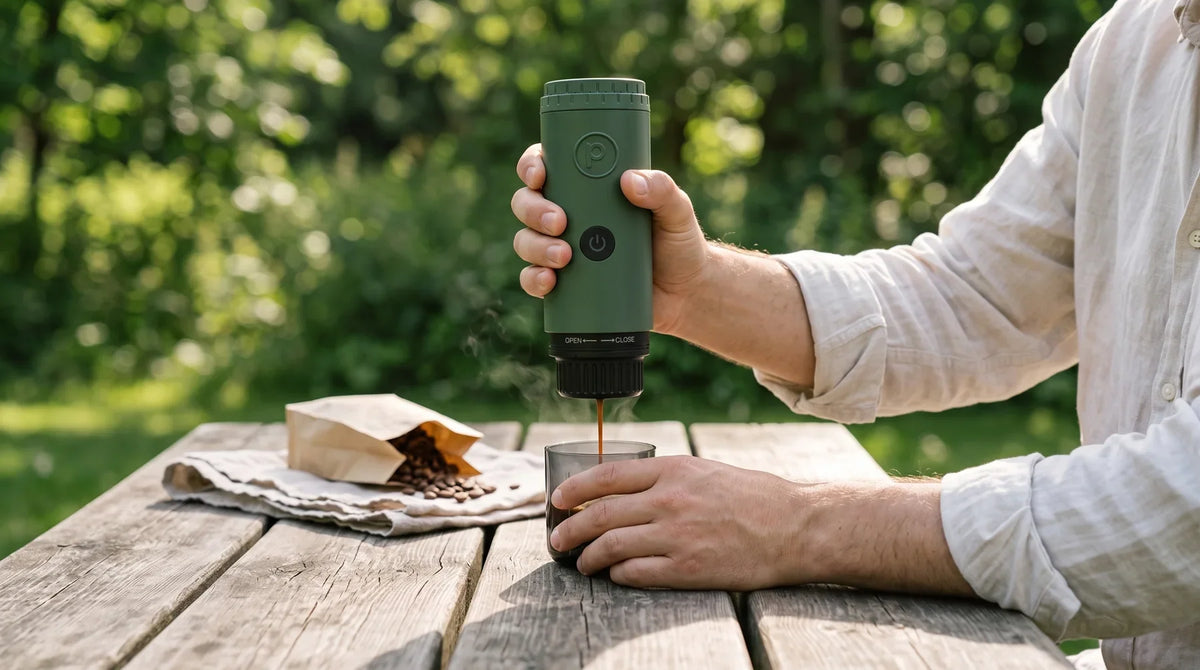
The difference is who does the work. With a press you heat the water and push or twist. With Origin you pour in water and press a button.
Brewing with a press
- Heat the water with a kettle or stove, or pour it from a thermos.
- Add ground coffee to the chamber.
- Pour in the hot water and stir.
- Press or twist to push the coffee through the filter into your cup.
- Rinse the chamber and filter.
Brewing with Origin
- Load your coffee: the grounds basket, or a pod in its adapter.
- Pour water to the line, cold or hot: 50 ml for a single, 70 ml for a double.
- Press the button: hold 2 seconds for cold water, double-press for hot.
- Rinse the basket or adapter and run one brew of clean water.
New to Origin? Our Origin guide walks through the first brew step by step.
The real cost of a portable coffee maker

The sticker price is only the start. Here's what each pick costs and what it asks of you every time you brew. We used each brand's US price on October 24–26, 2026.
Premierien Origin: $119, nothing else to buy
- Included at no extra cost: the grounds basket with lid, both pod holders and the travel cup.
- No kettle, thermos or stove needed: it heats cold water itself, on battery.
- Free shipping and 100-day returns on every order.
- The one catch: Origin is sold only on our site, not in stores or on marketplaces.
The other battery pick: HiBREW H4C Explorer, $118.20–139
- Buy the right version: the $109 Classic has no Dolce Gusto part.
- No milk pods: HiBREW's manual rules them out, so lattes from Dolce Gusto pods need another machine.
The no-heater picks: from about $35, plus hot water every time
- Wacaco Nanopresso, $64.90: a kettle or thermos for every shot, and pod adapters at extra cost.
- AeroPress Go, $49.95: hot water every time and paper filters to keep buying; no espresso.
- Wacaco Pipamoka, $49.90: hot water every time; ground coffee only; no espresso.
- Bialetti Moka Express, about $35–40: you need a stove and fuel every time. It's hand-wash only, and induction needs an extra plate.
Cost per brew: brew twice a week for two years, about 200 brews, and Origin works out to about 60 cents a brew before the coffee. There's no kettle, filter or fuel to add.
Premierien Origin: is it worth it as your portable coffee maker?
Want espresso where there's no kettle? Origin is worth a look. It's the only pick here that heats water on battery and takes all three kinds of coffee. If you always have a stove going and like a big mug, a press or a moka pot costs less.
Shipping is on us, wherever you are. Try Origin for 100 days on real trips; if it doesn't earn its place in your bag, send it back. Origin is our only espresso machine, so ask us anything about it.
Shop Origin: free shipping, 100-day returns
One machine for every coffee you pack
A grounds basket and two pod holders come in the box, and they swap in seconds. The same machine heats the water for all three.
Easy to look after
After each brew, rinse the basket, adapter or holder with a splash of water. At the end of the day, run one brew of clean water with no coffee and wipe the body with a cloth. Don't put the body under running water. A short routine like that keeps it ready for the next morning.
Who should buy Origin as a portable coffee maker?
Origin is worth a look if:
- You want espresso rather than a cup of coffee
- You brew where there's no kettle or stove
- You use more than one kind of coffee
- You care how it looks: four colors, same price
If you always have a stove and prefer a big cup, a moka pot or a press is cheaper. If battery life comes first, look at the HiBREW H4C Explorer.
Care most about heating? Browse our self-heating portable espresso makers.
Conclusion: which portable coffee maker should you buy?
The best portable coffee maker for you depends on the coffee you want and where your hot water comes from. For the biggest battery and black coffee, the HiBREW H4C Explorer. For the lightest espresso with a thermos, the Nanopresso. For a full cup, the AeroPress Go or the Pipamoka. For a camp stove, the Bialetti Moka Express.
For espresso anywhere, our top pick is Premierien Origin. It heats the water for you and costs $119 in four colors, with free shipping and 100 days to send it back. See the rest of our portable espresso makers, and add a rechargeable milk frother if you like lattes on the road.
Not sure which one fits? Email support@premierien.com. A real person reads every message.
FAQs
What is the best portable coffee maker?
For most people it's Origin ($119). It heats cold water on battery. It takes grounds, Nespresso Original compatible pods and Dolce Gusto compatible pods, milk pods included. If you always have hot water and want a full cup, the AeroPress Go is a simple, cheaper choice.
Are portable coffee makers any good?
Yes, if you match the type to how you'll use it. A battery espresso maker brews anywhere; a hand pump, press or moka pot is lighter and cheaper but needs hot water or a stove. With fresh grounds, the coffee can be as good as at home.
Is a moka pot the same as a portable espresso maker?
No. A moka pot needs a stove and makes a strong cup with little crema. A portable espresso maker uses a pump and makes a true shot, and battery models like Origin brew with no stove at all.
Can you take a portable coffee maker on a plane?
Usually, yes. Pack battery models in your carry-on with the tank empty. Origin's battery is 28.08 Wh, far below the 100 Wh most airlines allow in the cabin. Check with your airline before you fly.
What grind is best for a portable espresso maker?
A fine espresso grind, close to powdered sugar. Too coarse and the shot runs thin; too fine and the water struggles to get through. Presses and the Pipamoka want a coarser grind.
Do any portable coffee makers heat their own water?
Yes. Origin and the HiBREW H4C Explorer heat water on battery, so you can start from cold water. Our guide to self-heating portable coffee makers compares more of them.
Can you make a latte with a portable coffee maker?
Yes, two ways. Origin takes Dolce Gusto milk pods: brew the milk pod, then the coffee pod. Or pull a shot and top it with milk foamed in a rechargeable milk frother.
Nespresso® and Dolce Gusto® are trademarks of Société des Produits Nestlé S.A. Premierien is not affiliated with Nestlé.